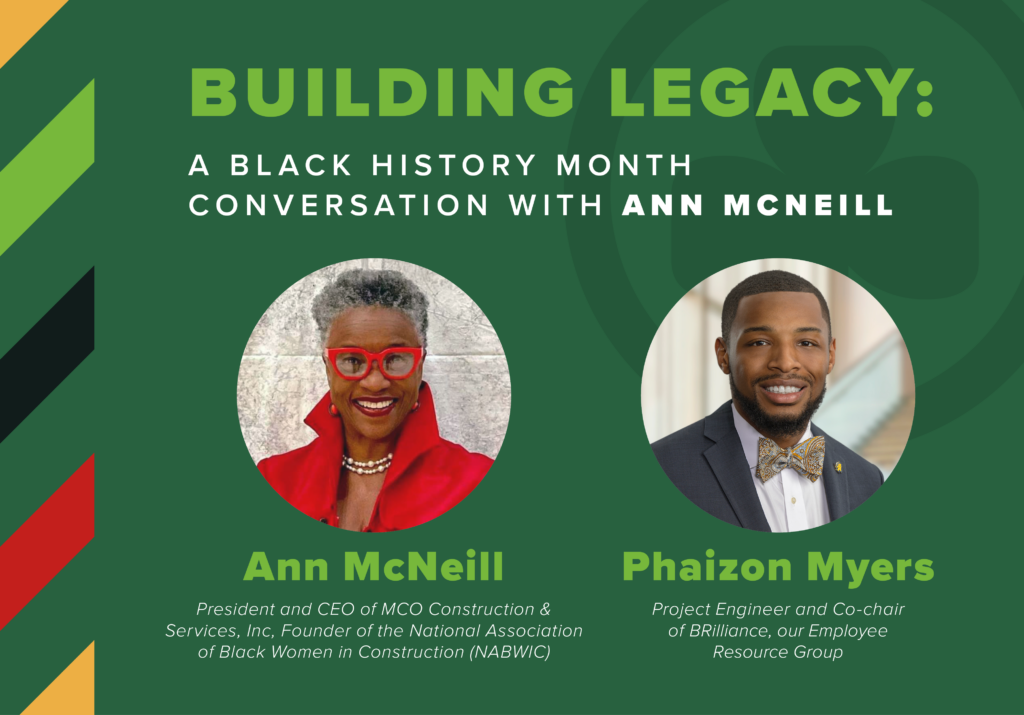
In honor of Black History Month, we hosted a powerful virtual conversation with Ann McNeill, President and CEO of MCO Construction & Services, Inc. and founder of the National Association of Black Women in Construction (NABWIC)
Moderated by Phaizon Myers, Project Engineer and Co-Chair of BRilliance, one of our Employee Resource Groups (ERGs), the discussion focused on reflection, resilience and the choices that shape leadership and personal impact in one’s career.
At Ryan, creating a positive, inclusive and supportive culture guides how we focus our resources to continually learn and encourage empowerment across all parts of our business. Conversations like this one, hosted in partnership with our ERGs, help us listen better, lead more thoughtfully, and foster a workplace where people can grow, feel seen and thrive.
Here are a few highlights from the conversation:
A Trailblazing Journey: Breaking Barriers
With more than 40 years in construction, Ann has built a legacy defined by courage, preparation and purpose. As one of the most influential Black women in the construction industry—and leader of one of South Florida’s few African American female-owned construction firms—she has contributed to some of the region’s most iconic projects while opening doors for others along the way.
Q: Throughout your career, you’ve often stepped into spaces where you were the first or the only Black woman. Can you share a moment when you had to break through a barrier, and what helped you move forward?
Ann: It was a project in my hometown of West Palm Beach—a $20 million project. I was a small business, and at the time, even smaller than small. I was commuting from West Palm Beach to Miami every day, and I didn’t realize then that in Miami I felt like [the Biblical story of] Joseph: being sold by his brothers, going from the pit to the palace to Potiphar’s house.
I decided to bid on this project, even though I hadn’t bid anything that large before. I identified a large white construction company in Tampa and asked them to partner with me as a joint venture. I flew over to meet the president and his team. He said, “Let me bring my team in and let’s talk about it,” because it was a hard bid.
His team came in and said, “Absolutely not. It’s a hard bid. We don’t need her.” I remember one of the estimators slammed his snuff cup on the desk and said, “We don’t need her. We’re either low or we’re not. We don’t need her.”
I looked at the president and said, “But we can win this. What do you have to lose?”
He said, “You know what? You’re right. What do we have to lose?” and told them to work with me.
He then asked, “Do you know what you have to do?” I said yes. I have two general contractor licenses. I own the business 100%. I didn’t need to check with anybody. I had to qualify the business with my state, and I did.
There were 12 bidders. Twelve. We were number six out of 12 on a hard bid—low bid. Nine months later, we won. That’s an example of breaking through a barrier.
What I did differently—and this goes back to the story of Joseph—is that during those 20 years of going back and forth to Miami, I was learning how to win major programs and projects, not just bid them. I knew politically I didn’t have the votes, but I worked like it all depended on me and prayed like it all depended on God.
I build people. I build communities. I made sure I put everybody I knew in my neighborhood on that project.
And here’s the irony: when they opened the bids and we were ranked number six, my partner walked off and left me. He said, “We’re number six. We lost.”
I said, “No, no, no. We can win this.” He said, “Miss McNeill, we’re not second. We’re not fourth or fifth. We’re number six. You don’t win a hard bid at number six.”
But we did.
Q: Construction has changed immensely since you started. Beyond technology, what is the most significant shift you’ve seen in how the industry approaches diversity and leadership?
Ann: I will go back to the example that I just shared. For me, it is political, and that is the major shift that I’m seeing. And it doesn’t take a rocket scientist to know that.
All politics are local.
A lot of times, we get caught up in what’s happening nationally when we talk about diversity. But when you stop and think about it — who do you vote for in your school board district? Who do you vote for in your city or your county? Do you know them? And do they know you?
That, to me, is the answer to the question, because that’s what I’ve done.
The Vision Behind NABWIC: Turning Contacts into Contracts
Ann founded the National Association of Black Women in Construction (NABWIC) to create intentional pathways for mentorship, advocacy and economic opportunity. Her mission is rooted in empowerment, helping women turn contacts into contracts and strengthening representation across public and private sectors.
Q: What inspired you to start NABWIC and what impact are you most proud of today?
Ann: When God laid it on my heart to start this organization, I ran from Him for 10 years. I did not want to do it. He slow-walked me down. What does that mean? When I had been in this business for about 20 years, I kept seeing people who looked like me—one here, one there, male, female. And I kept saying, “We should connect, we should get together.” I kept doing that.
Eventually, the numbers kept getting greater and greater, and all of a sudden, I got a call one day from a lady who said, “God told me to call you, and you’re supposed to help me.” And this was the beginning of the National Association of Black Women in Construction. I settled down and started the organization with a handful of women.
Our vision for the National Association of Black Women in Construction is to build lasting strategic partnerships with first-rate organizations like Ryan Companies and with individuals who can provide groundbreaking and innovative solutions for Black women in construction and their respective communities. I know we are the voice of Black women in construction.
Leading From Wherever You Are
Ann emphasized that leadership starts with mastery of your craft and building strong relationships. She shared how becoming an expert in your profession and intentionally connecting with others in your field can create influence and opportunities, regardless of title or role.
Q: Many people feel they need a title to lead. What advice would you give to someone who wants to lead from wherever they are, whether they’re new to their role or early in their career?
Ann: You are in the business of your craft, your profession, your expertise. Are you an expert in your profession? Are you known for your skill set as an expert—whether you’re a clerk, a lawyer, a CPA, a project engineer, or an architect—regardless of the position you have in the firm, are you an expert in that? Are you certified in that? So when you think about moving up, look at where you want to focus your industry in terms of your expertise.
Now, the relationships are in your profession. The relationships are also in your craft. The relationships are also in the industry that you’re in.
For example, if you are an engineer, are you a part of the engineer’s association? I’m not an engineer, but locally, I’m the treasurer for our local engineer association.
Why is that important to me? Because those are the people my clients are, and I want those relationships. People go out of their way to do business with people they know, like, and trust.
Purpose, Growth and Owning Your Voice
Aligning work with purpose is central to Ann’s approach. She emphasizes mindset, vision, and using every opportunity to build people, businesses, and communities alongside the projects she leads.
Q: How has aligning your work with your purpose shaped your success, and how can others begin identifying their own?
Ann: You are in the business of your mindset… You must have a dream to have a dream come true. That’s how I started.
I don’t just build buildings with my clients. I look to build individuals who will build businesses, who will build communities, and every single opportunity that I get, whether I work with a developer or a contractor, this is what we focus on.
A Vision for the Future
The conversation closed with Ann sharing her vision for the future—one where confidence, faith, and the willingness to do the work drive the next generation of leaders, and where opportunities for Black women in construction expand locally and globally.
Q: When you look at the ‘skyline’ of the construction industry 20 years from now, what is one thing you hope is radically different and one thing you hope never changes?
Ann: Well, the one thing that I believe—and I go back to mindset, how I started—is that if we have the highest confidence in who we are and whose we are… the limitations are a practice. It’s a daily practice, having the faith and belief in the infinite—whatever that means for you—to know that you can have a dream and that dream can come true. I’m living my dream, and I believe we’re all living our dream.
It just depends upon what you’re dreaming, right? That is what I hope does not change—the faith, belief, and confidence in the One that’s in you. But we have to be willing to do the work.
Now, what I hope does change is our desire to serve mankind. When you ask me what I would like to see, I really would like to see the National Association of Black Women in Construction in every city, in every junior high school, and in every elementary school. Because think about this: where can a Black woman go who did not finish high school, did not get her GED, never went to college, does not have a PhD, and has five or six children? Where can she go and make $20, $30, $40, $50 an hour? Where can she start a business without all those degrees? In construction. We don’t talk about that enough.
That is what I would like to see, and that is what I am working toward until my last breath—planting chapters all over, not just in the United States, but internationally. We’ve been contacted by organizations and Black women in other countries wanting to know how they can start chapters too.
So I would say seeing this organization all over the world—Black Women in Construction—while also including our brothers—is what I hope for.