At Ryan, we’re proud to work alongside remarkable women whose leadership and expertise strengthen our teams, inspire progress on our project sites and the properties we manage, and elevate the communities we serve. Their contributions drive our success and move our company forward, demonstrating the value of diverse voices in every part of our business.
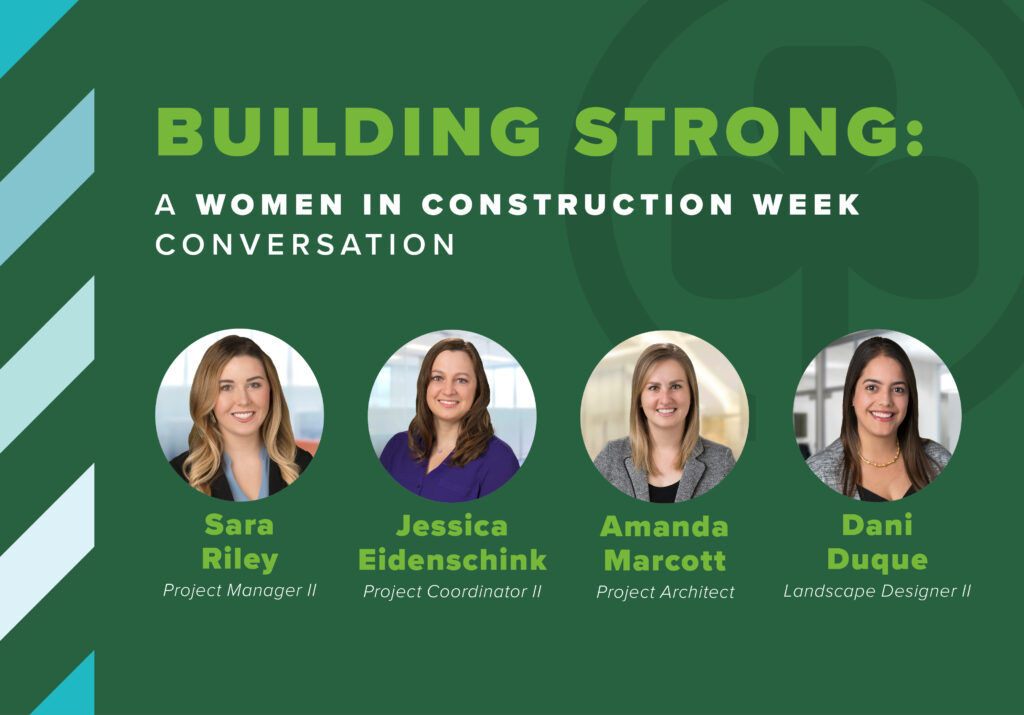
In honor of Women in Construction Week, we hosted a panel discussion with some of our female powerhouse team members:
- Sara Riley, Project Manager II, five years at Ryan
- Jessica Eidenschink, Senior Project Coordinator, four years at Ryan
- Amanda Marcott, Project Architect, five years at Ryan
- Dani Duque, Landscape Designer III, six years at Ryan
Moderated by Doug Woolever, Director of Construction, this conversation highlighted how the team collaborated to cultivate a high-trust, high-performing project environment and how they defined success beyond project schedule and budget by strengthening community and collaboration.
Let’s look at the highlights from the conversation, including what inspired their careers in construction and the technical and soft skills that help women “Level Up” in today’s male-dominated industry.
Q: Could you share what inspired you to build a career in construction?
Sara: I have a little bit of a story and a person who inspired me and really got me to where I am today. For me, it’s 100 percent my dad—he’s definitely the reason I’m here today. I grew up in a household full of construction lingo and construction talk at the dinner table. My dad founded and owned a commercial contracting company, so hearing all of his stories day to day really showed me how many directions this career can take you and how exciting it can be.
One core memory that comes to mind was when I was about ten years old. My dad was working on a Sun Country airline hangar, and he brought me along when they were doing the dry system flush test. It was a big deal—it was even on the news. I got lifted up into a bucket lift in the middle of the hangar while all the foam came down around me. I remember standing there thinking, “Wow, this is so cool.” There were so many different people involved in making that moment happen, and I knew that was something I wanted to be part of.
I’ve always been mechanically inclined, so pursuing a degree from the University of Wisconsin–Madison in Civil and Environmental Engineering, along with a certificate in Construction Management—just made sense for me. Thanks to my dad, that’s why I’m here today.
Jessica: I kind of fell into construction through a very non-traditional path. I actually have a degree in psychology. After college I worked at the University of Minnesota Medical Center as the aquatics program coordinator, where I oversaw rehabilitation pool programs like physical therapy, occupational therapy and aquatic therapy.
In 2010, when the economy took a downturn, our entire department was laid off. With my severance check, I decided to find a fun job and moved to Colorado, where I became a ski instructor and coached a development team in Vail.
After a few injuries, I realized I needed something less physically demanding and moved back to Minnesota. A temp agency contacted me about a project coordinator role with a general contractor. I told them straight up that I knew nothing about construction and didn’t think I was qualified. They encouraged me to go to the interview anyway just to practice.
I said the same thing in the interview—that I didn’t know anything about construction—and they told me they didn’t care because they could train me. Before I even got home, they called to offer me the position. That’s how I ended up in construction, and nine years later, here I am.
Dani: My path was a little more linear. I have a degree in architecture from Colombia, where I’m from. After graduating, I worked in architecture for a few years, but I realized that the building scale wasn’t what I was most excited about.
When I moved to the United States, I saw it as an opportunity to pursue a master’s degree in something that aligned more with what I enjoyed—being outdoors, working at a larger scale, and thinking about how spaces serve people and connect with buildings. That’s how I ended up at the University of Minnesota, where I completed my master’s in landscape architecture.
And that’s how I ended up at Ryan.
Amanda: I also took a pretty linear path into architecture. If I go back in my memories, the spark probably started in high school when I was part of the electric vehicle team. I was the first girl to be in the class, so they had to change the permission slips for our races from “my son” to “my child,” which was kind of cool.
I helped design the car and ended up being the driver because I was also the smallest one. That experience led me to initially pursue engineering. Later I took an architecture class for fun and realized that’s where my passion really was, and the rest is history.
THE VISION BEHIND: PROJECT WRANGLER
Q: To begin, could you please give us an overview of Project Wrangler?
Sara: For those in the industrial world, Project Wrangler is an ADZL last-mile distribution warehouse with mixed office and training spaces. It was also a Ryan development and architecture and engineering project, which definitely contributed to the success of the job.
The building is about 225,000 square feet and features three outbuildings. One functions as a Jiffy Lube, one is a truckers’ restroom, and another is an auto vehicle scan building. The site also includes a large retaining wall on the north side, which was quite a feat, along with two retention ponds.
We also incorporated a 216-stall EV lot with room for future expansion. The project ran on a twelve-month schedule—we started last March and achieved temporary Certificate of Occupancy in early February.
Q: On Project Wrangler, what made the team dynamic so effective? How do you define a “successful” project beyond just time and budget, focusing on the strength of the community you built?
Amanda: I think our team was successful beyond time and budget because of our team dynamic. It was top notch. The entire team created strong and lasting relationships not only with each other but also with our construction manager from Amazon.
We were able to keep that relationship both fun and professional, which is important. We had great meetings on site but also did fun things together that helped build those relationships. That connection helped us build trust that we can build on to continue working together on future projects.
Jessica: Success for me was how much fun our team had together. We had great camaraderie, which made coming to work every day something to look forward to.
We had several potlucks on site, including a Thanksgiving-themed one we called “Wrangler Giving,” complete with smoked turkey and all the traditional sides. Everyone signed up for something to bring, which was a lot of fun.
We also did an arts-and-crafts day where we decorated the trailer with snowflakes cut out of old plan sheets. The last time I was out there, they were still up. We also did happy hours and outings, including going to a Wild game together. It really created a strong bond across the team.
Q: What does a high-trust team look like on a construction site, and how do you intentionally build that?
Dani: This project was unique for me because there were so many women on the team—and that happened organically and wasn’t intentional.
I also knew several people on the team before the project started, which made it easier to walk into the trailer and know who to talk to. That familiarity created a sense of ease and comfort.
We also had a great partnership with our superintendent, Joe. We had a couple of challenges with some of the trees and some of the planned locations that ended up changing, and it never felt like this huge mistake. It always felt collaborative: “How can we talk to the city? How can we fix this? What is the right way to do it?”
Sara: Building a high-trust team isn’t just about showing up every day—it’s about how you manage the project and how you see your project as a whole. You have to be there for the whole team.
At Ryan we often say “One Ryan,” meaning we’re all working toward the same goal of delivering a successful project. On this project we joked about being “One Wrangler.”
Kelly and I split up scopes of work, but we also supported each other when things got busy. If someone had the capacity, they stepped in to help. There was no finger-pointing on our jobsite—it was only a problem-solving mindset.
Our superintendents were wonderful. We’d sit down together, talk through challenges as a team and focus on how to move forward. That kind of environment doesn’t happen by accident—you have to be intentional about it. And of course, we had a lot of fun along the way. I’ve had wonderful project teams here at Ryan. I really haven’t been part of a single team that hasn’t worked well together. But for some reason we just had a ton of fun. So maybe it’s the girl power, I don’t know.
BUILDING SUCCESS: IN AND OUTSIDE THE FIELD
Q: As we see more women “Leveling Up” across the industry, what is one technical and one soft skill you believe is most crucial for building a strong career in today’s construction landscape?
Jessica: Soft skills are huge. Multitasking and prioritizing are really important, but open communication is key. It helps make sure everyone across the team—construction, design and ownership—is on the same page and able to prioritize the most urgent issues.
Sara: One technical skill I can’t stress enough is knowing your contract type. The first thing I do on every project is sit down and read the contract cover to cover.
You need to understand exactly what you signed up for—what type of contract it is, what contingencies exist and what you’re contractually obligated to deliver. Knowing that information isn’t just an insurance policy—it’s a strategic tool you use throughout the project.
When you understand the contract, you’re thinking about risk, leverage and profit. Technical knowledge builds credibility, but communication builds your influence.
Q: The theme also highlights building strong “Communities.” What is something you do outside of work—either for personal growth or to support your community—that has helped you “level up” in other areas of your life?
Amanda: I’ve been able to participate in ACE mentoring, which pairs industry professionals with high school students. The students work through an entire building project—from planning and design to estimating and scheduling.
It’s incredibly rewarding. I’ve worked with some students since they were freshmen, so watching them grow over four years and develop their critical thinking and presentation skills has been amazing. Two of them are even going to school for architecture next year.
Programs like this help the students level up, but they also help me grow as a leader and mentor, which translates directly into my work at Ryan.
Dani: I’m involved with Women in Landscape Architecture through the American Society of Landscape Architects here in Minnesota, and I currently serve as a co-chair.
It’s a great way to meet other women who are doing what I’m doing or are going to school to do what I do. There’s a lot of events that we host, and even mentorship opportunities.
And I will plug our employee resource groups (ERG). I know the question was outside of work, but I do think being part of an ERG is important to give back to our communities and stay connected to people. Plus, a lot of times, we host events or get together outside of work. I also like to go to other events, like yoga classes, where I can meet people with different views of the world and perspectives, and who have other professional careers.
PURPOSE AND GROWTH IN THE INDUSTRY
Q: What do you consider an “untapped resource” when it comes to recruiting and inspiring the next generation of construction professionals?
Amanda: I feel like a lot of my answers come back to students because I spend quite a bit of time working with them. For the past six years, I’ve been part of the Design Student Alumni Board at the University of Minnesota College of Design. Our goal is to serve as a conduit from college to career as students transition from school into the real world.
I think an untapped resource is actually the students themselves—the people coming up in the design and construction fields. It’s important that we stay connected to them so we can create workplaces that meet the changing needs of the next generation.
Something that worked five or ten years ago might not work now. Being flexible and open to new ideas is critical—not just for emerging professionals but also for those of us who have been in the industry for years. Students and younger professionals bring fresh ideas about projects, workplaces, and collaboration. For companies to be successful, we need to tap into that perspective and create an environment where they can thrive and learn rather than assuming we already know best.
Jessica: As I mentioned earlier, I came into the industry through a very atypical path. Because of that, I think it’s important not to overlook someone who doesn’t necessarily have the background you might expect.
Soft skills are often harder to teach—things like critical thinking, time management, work ethic, and attitude. Some technical skills are necessary for certain roles, but many can be taught over time. What’s harder to teach is a willingness to learn and a positive mindset.
If someone has those qualities, they can grow into the role and develop the technical knowledge they need. That’s something we should keep in mind when recruiting the next generation.
Q: In an industry that has historically been designed – from PPE sizes to communication styles – for men, how do you navigate between ‘fitting in’ to the culture and ‘standing out’ as a leader?
Sara: First, I have to touch on the PPE side of things. Finding women’s safety gear that actually fits—and is warm—can be really difficult. We ordered six to eight different safety jackets to try, and we still ended up with a men’s jacket. It’s super long, tight in the hips, and the sleeves are way too long, so I have them rolled up. That alone tells you something about how the industry has historically been designed.
But when it comes to navigating between fitting in and standing out as a leader, I try to stay true to myself. Sometimes I go to the job site with my hair done and my nails done. That’s just who I am, and that’s okay. It might get a look here or there, but it doesn’t make me any less competent or capable of doing my job.
Construction isn’t about your hairstyle or what you’re wearing—it’s about the work you produce and how you carry yourself. I try to hold myself to a professional standard while still being authentic.
One piece of advice someone once shared with me really stuck: you don’t need to trade your authenticity for authority. I think that’s an important message for the next generation of women entering the industry. Culture doesn’t shift overnight—it shifts one person at a time.
Dani: I really liked what Sara said about authenticity. Communication is very important in our industry, but that doesn’t mean you have to change who you are in order to get your message across or to prove what you know.
English is my second language, so sometimes that’s very challenging for me personally. Sometimes I’ll be talking to someone and I will forget the word, or I’ll want to say something, but I get frustrated because it’s not coming out the way I’d like it to. So I will say I’ve been working a lot on the ways that I communicate—and cultural things do play a role in that—but that doesn’t mean I will change who I am.
As far as PPE, or construction clothes, I have found that I’m very short—barely 5’1”. So I have found that not a lot of things fit me. So what I do is every time I see someone at the office wearing something that I like or that is for jobsite visits, I will ask them what size they’re wearing since it looks good on them. And if it’s a jacket, I’ve even asked to try it on.
I have found asking people what they’re wearing or using, and where they bought it, has been very helpful in finding things to wear.