The Challenge
What began as a straightforward goal—to expand cardiology services and meet rising demand in Eastern Iowa—quickly became something more.
As our integrated design-build team partnered with Mercy Medical Center, early conversations revealed that this project was not simply about adding space. Mercy’s leadership and clinical teams were clear: the facility needed to support how care is delivered, how staff collaborate and how patients (particularly older adults) experience the environment.
Through ongoing dialogue together with our team, two priorities emerged directly from Mercy’s feedback:
- Operational alignment: Re-evaluating clinic workflows to support efficiency, clarity and coordinated care.
- Patient-centered design: Creating an environment that reflects the needs of Mercy’s core patient population, with intuitive wayfinding, safe transitions, and spaces that reduce stress and confusion.
What could have remained a capacity expansion became a broader opportunity: one shaped by listening, refinement and continuous input from the people who would ultimately use the building every day.
The Solution
The 72,000-SF Jewel & Jim Plumb Heart Center was delivered during the height of the global pandemic, when supply chains were strained and pricing was volatile. Our integrated design-build approach allowed our team to respond quickly to both market realities and client feedback, streamlining decisions and enabling early procurement of long-lead materials such as structural steel and curtain wall systems.
But just as important as how the building was delivered was how it was designed.
Mercy’s leadership, physicians and facilities teams consistently guided the project in collaboration with our team, influencing both layout and experience:
- The ground floor was shaped around accessibility and welcome, with a two-story lobby, rehab and physical therapy spaces (including an indoor-outdoor track), imaging, flexible conference rooms, a café and a non-denominational peace room.
- The upper level was organized around clinical flow, housing 72 exam rooms and staff support areas designed to reduce travel distance and improve coordination.
Our design elements directly reflected and prioritized Mercy’s input and values:
- Faith-based identity: Custom illustrations and environmental graphics were incorporated to honor Mercy’s roots and reinforce its mission.
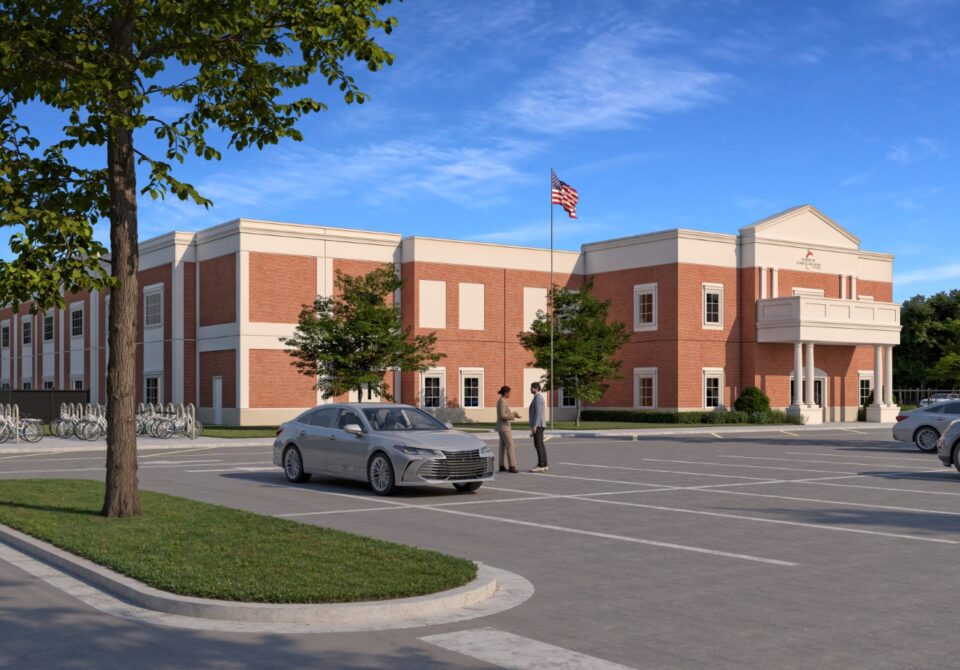
- A welcoming exterior: Angled and colored feature glass—referencing Mercy’s historic stained glass—was paired with traditional red brick to modernize the campus while remaining authentic to its history.
- Clarity for patients: Large navigation graphics, simple flooring patterns and a color-coded hallway system were introduced in response to feedback about wayfinding and ease of movement.
- Reimagined waiting: Square footage was intentionally shifted from traditional waiting rooms into care and staff spaces, with smaller sub-wait zones and dedicated areas for pediatrics and older adults based on operational and patient-experience priorities shared by Mercy’s teams.
- Exam room design: Chair-centric layouts were selected to improve comfort for patients and functionality for staff.
Each design decision was the result of iteration, discussion and alignment, ensuring the facility reflects how Mercy delivers care rather than a one-size-fits-all solution.
The Process
From the outset, Mercy Medical Center emphasized the importance of partnership. Design-build became not just a delivery method, but a framework for listening, adapting, and responding in real time.
Listening to Operations
Our design team spent time shadowing clinical staff and engaged more than 40 stakeholders—from physicians to facilities managers—to understand patient movement, staff workflows and day-to-day challenges. These conversations directly informed room layouts, circulation paths and adjacency planning, making sure the building supports Mercy’s operational goals rather than dictating them.
Collaborating Early and Often
With construction expertise embedded during the design phase, our team could immediately evaluate ideas for constructability, cost and schedule. This allowed Mercy’s feedback to be tested in real time, balancing vision with practical execution and eliminating late-stage surprises.
Mitigating Risk Together
In response to pandemic-era uncertainty, our experts identified long-lead materials early and initiated procurement in advance.
Our approach (developed in close coordination with Mercy) helped shield the project from price escalation and supply delays, providing a level of predictability during an unpredictable market.
“Ryan was a fantastic partner and helped us navigate the project through challenging market conditions; their efforts and planning before we broke ground helped to insulate Mercy Medical Center from price hikes and procurement delays. The building is a beautiful addition to Mercy Medical Center’s campus in downtown Cedar Rapids and the functionality has been valuable as we brought cardiovascular services under one roof.”
— Jim Atty, FACHE, Former Executive Director, Jewel & Jim Plumb Heart Center at Mercy Medical Center
The Results
The completed facility supports Mercy Medical Center’s mission by providing a highly functional environment designed to enable efficient operations, coordinated care, and a welcoming patient experience.
Because the team remained closely aligned with Mercy throughout design and construction, key outcomes reflect both operational priorities and long-term value:
- Improved Program Flow: Staff input and operational shadowing shaped layouts that support efficient movement between waiting, exam, and support spaces.
- Community-Focused Design: An underutilized street was transformed into a pocket park, creating a welcoming environment for patients, families, and the broader community.
- Accessible Health Education: CPR/AED training stations and a flexible education room reinforce Mercy’s commitment to community heart health.
- Coordinated Care Environments: Centralized collaboration zones positioned physicians closer to care teams, supporting communication and alignment across disciplines.
Together, Mercy Medical Center and our project team established a scalable, patient-centered model for healthcare design: one grounded in listening, collaboration and shared problem-solving.