A workplace where everyone belongs doesn’t happen by accident.
It’s reflected in how we recruit, how we support team members, the partners we work with and the communities we invest in.
That’s the idea behind this year’s Construction Inclusion Week theme: “Opening Doors, Building a Workplace for Everyone.”
So what does building a workplace where everyone belongs look like at Ryan?
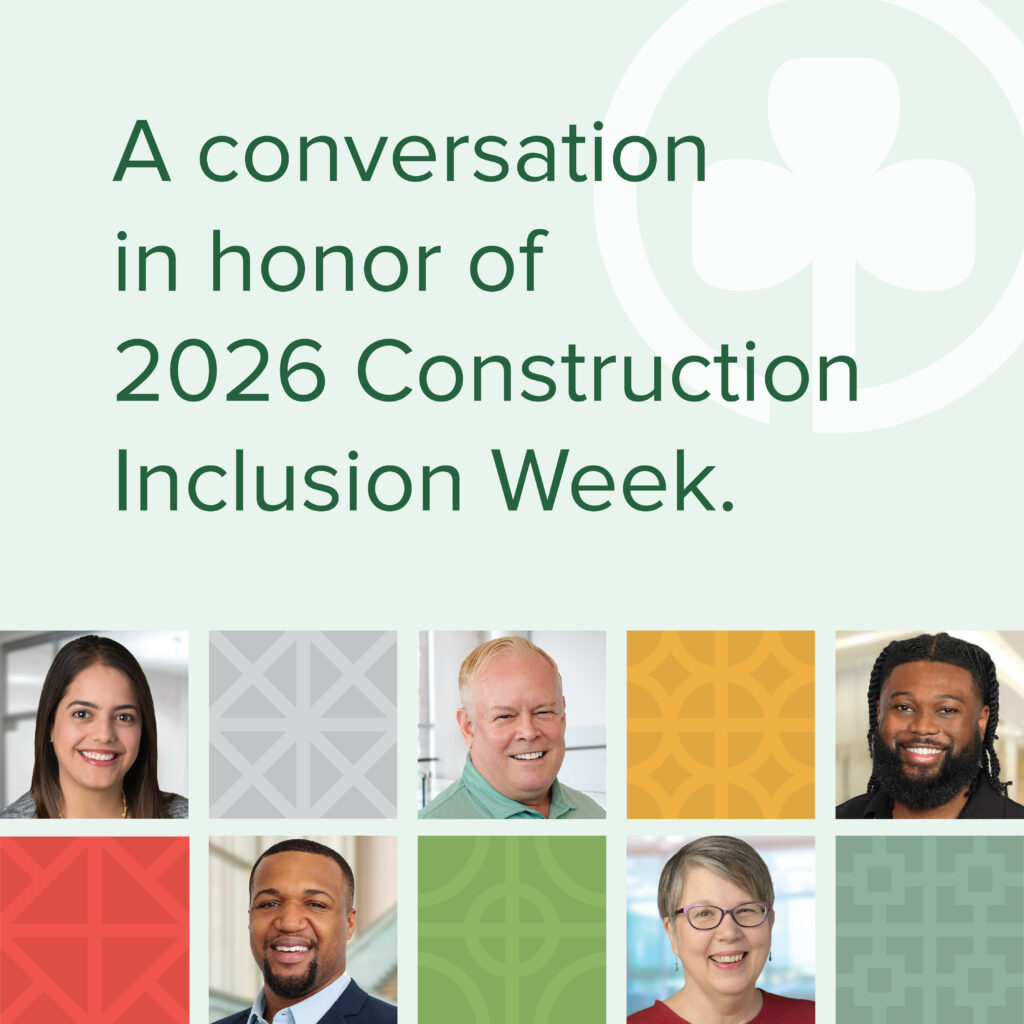
Tim Thomason, Director, Engagement and Community; Elizabeth Campbell, National Director of Emerging Business Inclusion; Kahlil Bostick, Community and Workforce Experience Manager; Dani Duque, Landscape Designer and Co-Lead of Ryan’s Employee Resource Group Amigos, and Dave Offer, Senior Recruiter; discussed how inclusion shapes the employee experience, strengthens our workforce, creates opportunities for business partners and helps us make a positive impact in the communities where we live, work and build.
What does this year’s Construction Inclusion Week’s theme, “Opening Doors, Building a Workplace for Everyone,” mean to you?
Tim Thomason (TT): It means creating opportunity, and creating opportunity starts with ensuring we’re connecting with talented people from a wide range of backgrounds and experiences. You can’t recruit diverse talent without creating a workplace where people feel welcomed, valued and able to thrive. All these factors must go hand in hand.
At Ryan, we’ve made intentional efforts to broaden our recruiting strategy. Rather than relying primarily on one source, we’ve expanded where and how we recruit to reach the widest possible pool of qualified candidates. This inclusive approach helps us identify, attract and hire the best talent available.
But our commitment doesn’t stop with hiring. We’re also focused on creating an environment where team members want to stay, grow and build their careers.
Dani Duque (DD): To me, inclusion isn’t about checking a box. It’s about the steps we take to get there.
That means continually evaluating what’s working, listening to feedback and asking whether opportunities exist at every level of the organization. It’s about being intentional and making sure inclusion is part of how we operate every day.
Elizabeth Campbell (EC): The phrase that comes to mind for me is “intentional on purpose.”
Whether we’re talking about recruiting talent or engaging business partners, the goal is to create access to opportunity.
In Emerging Business Inclusion, that means intentionally identifying and engaging a broad range of qualified businesses because doing so brings excellence, innovation and new perspectives to our projects.
How do Employee Resource Groups (ERGs) help create a sense of belonging at Ryan?
DD: One of the things I’ve loved most about ERGs is the opportunity to connect with people I otherwise never would have met.
Through AMIGOS and other ERGs, I’ve built relationships with employees across the country, creating a sense of community that’s bigger than a single office or region. It’s also created opportunities to showcase Hispanic and Latino culture, host meaningful conversations and bring in outside experts to help us learn and grow.
The best part is that there are so many ways to participate. You can lead, volunteer, attend events or simply show up and learn. All of those things matter.
Dave Offer (DO): When people see others from similar backgrounds succeeding somewhere, they feel a stronger sense of connection and belonging. People want to know they’ll be part of an environment where they can find connection and community, and when we recruit, they get excited to hear about our Employee Resource Groups.
Why is it important to create pathways in our industry for a wide range of people and experiences?
DO: Many people simply haven’t been exposed to the opportunities available in construction and real estate.
Many people simply haven’t been exposed to the incredible career opportunities available in construction and real estate.
Veterans are a prime example. Through our Employee Resource Group, Shamrock 6, and other partnerships, we are helping service members see how their unique skills translate into rewarding careers at Ryan. Service members bring a wealth of experience in leading diverse teams under high-pressure conditions while staying focused on a unified mission—a perspective that is invaluable to our workplace.
Ultimately, we want to build the strongest talent pipeline possible. Future superstars can come from any background, including those historically underrepresented in our industry, and we must actively seek out and support that talent. Our goal is to create pathways for talented people and ensure they feel valued, included and empowered to show up as their authentic selves.
Elizabeth, what is Emerging Business Inclusion (EBI), and why does it matter to Ryan?
EC: Emerging Business Inclusion is Ryan’s effort to increase participation among third party-certified diverse businesses in our contracting opportunities.
At its core, EBI is about creating access to opportunity. We’re creating pathways for qualified businesses to compete, build relationships with us and grow their businesses.
By intentionally engaging in a broad range of businesses, we create opportunities while also bringing additional talent, expertise and innovation to our projects. This work brings added value to Ryan and our clients. The impact extends beyond individual projects. Small and Diverse-owned businesses often hire from the communities they serve at higher rates. This means when we enter into contracts, we are also generating a positive economic impact in the communities from which these businesses hire.
Kahlil, as Community and Workforce Experience Manager, how does your role contribute to Ryan’s broader approach to inclusion and workforce development?
Kahlil Bostick (KB): My role gives me a unique vantage point because it brings inclusion directly to our project sites and the tradespeople building our projects every day.
Workforce initiatives are often designed with corporate offices in mind, but our field teams experience the workplace in a very different way. My focus is on being intentional in how we support field personnel and create connections between our regional offices and active project sites.
At the end of the day, the goal is simple: ensuring every team member, regardless of where they work or what role they play, feels seen, valued and connected to Ryan’s culture. When that happens, workforce engagement and inclusion stop being abstract concepts and become part of the everyday experience.
Can you share an example of how Ryan is creating opportunities in the communities where we build?
KB: One example that stands out is our partnership with Newton College & Career Academy in Covington, Georgia, where we supported the school’s annual Tools & Trades Expo.
During the event, we met Mario Calderon, a graduating senior with a passion for commercial construction. After connecting with him at the expo, our team brought him into Ryan’s talent pipeline and guided him through the interview process.
Today, Mario is a Junior Field Engineer on our Mission Critical team.
That single partnership not only helped launch a promising career, but it also brought exceptional talent to Ryan. It’s a great example of how local community investment can create a lasting impact for both our business and the communities we serve.
When you look across employee experience, workforce development, business inclusion and community engagement, what connects all of these efforts?
TT: For me, it comes back to creating opportunity.
Whether we’re talking about recruiting, team member experience, supplier inclusion or community engagement, the goal is to make sure people have access to opportunities and feel they belong when they get there.
We know we’re not a finished product. There’s still more work to do. That’s why we’re continuing to look at our systems, our processes and the experiences people have at Ryan. The more transparent and consistent we can be, the more opportunity we create for everyone.
DO: What resonates with me is Ryan’s values. Throughout my career, I’ve seen a lot of organizations talk about values, but here, they’re part of how we operate every day: Safety. Integrity. Respect. Stewardship. Family. Excellence. Fun.
To me, those values are closely connected to inclusion. They help define how we treat one another and how we show up as an organization.
Continuing the Conversation
Throughout this conversation, one theme surfaced again and again: creating opportunity and being intentional about inclusion.
It shows up in how we attract talent, foster belonging, support business partners and engage with the communities where we live, work and build.
As we recognize Construction Inclusion Week, we’re reminded that building a workplace for everyone isn’t the responsibility of one team or one initiative. It’s something we build together.